
We have seen one of the most interesting results of geometric algebra: reducing complex numbers to the operation of rotation, expressed by means of the rotor  . This means that the function
  is interpreted differently depending on the kind of object represented by the unknown. If it is a scalar, we get the ordinary exponential, but if it is a bivector, then we get a rotation operator. What remains to be understood is the unit of measure of this bivector.
In this regard we observe an asymmetry: in the circular functions the argument is naturally an arc (in red), whereas in the hyperbolic ones it is twice the area of the sector (in yellow). The reason is a deep one: on the circle, the arc of length  and twice the area of the sector give the same number, and we may use either one interchangeably. On the hyperbola this freedom does not exist — the length of the hyperbolic arc does not coincide with the parameter that generates the functions, and the only natural “bridge” is the area. It is therefore the area, not the arc, that is the notion working in both cases.
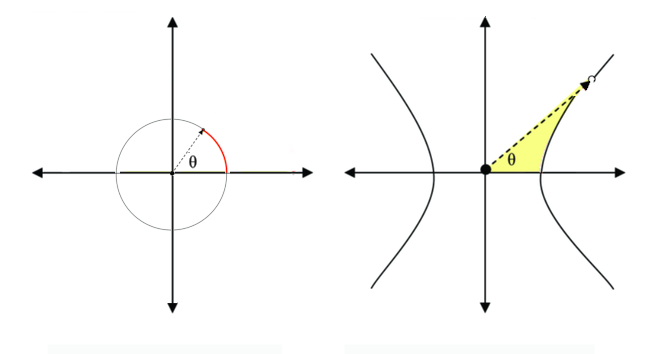
Let us try to rethink the concept of rotation: what does it mean to rotate by an angle ? How do we choose it? How do we visualize it?
Typically the angle is the dimensionless quantity defined in a circle as the ratio between the length of the arc and the radius:  . The full angle is therefore:
(1) 
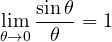
The radian is the unit chosen to simplify the expression of the trigonometric functions, in particular of the notable limit:
(2) 
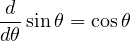
from which other equally simple expressions then follow, for example
(3) 
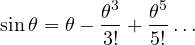
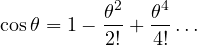
or their series expansions:
(4) 
(5) 
If there were other definitions of the angle, the expressions above would carry along conversion factors and their powers.
In principle we may choose any definition we like, provided it leaves the argument dimensionless. Let us then try measuring the angle by means of the area of the sector instead of the arc. This is not a different unit: for every circular sector the identity  holds, from which
(6) 
The factor of 2 is not an arbitrary adjustment — it is exactly what appears in the formula for the area of the sector. As a result, the “areal” angle defined in this way always coincides, and not only for the full angle, with the usual “linear” arc/radius angle:
(7) 
What changes is the geometric interpretation (an oriented area rather than an arc), not the numerical value. And, remarkably, this same quantity — twice the area of the sector — is precisely the argument used in the hyperbolic functions.
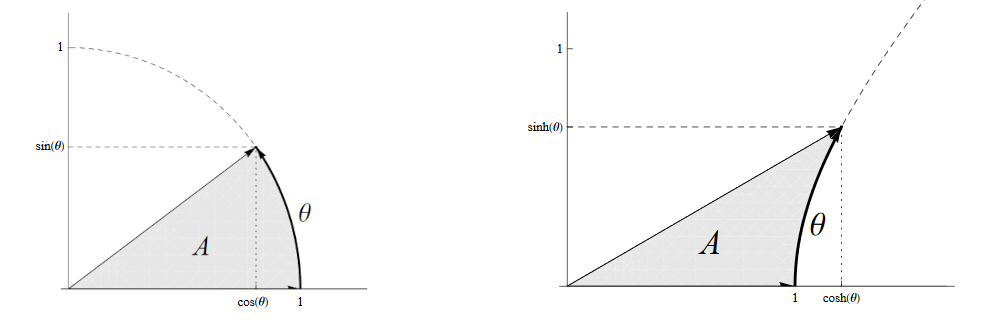

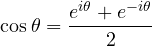
The circular trigonometric functions are defined as follows:
(8) 
(9) 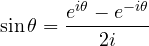
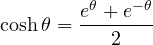
and they work regardless of whether the angle is interpreted in a linear or an areal way. The hyperbolic functions, for their part, take on the structurally symmetric form
(10) 
(11) 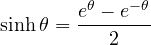
if and only if the argument is taken as twice the area of the hyperbolic sector. That the same holds for the circular counterpart is not a coincidence: it follows from the very same identity ( on the circle,
  on the hyperbola), which in geometric algebra is one and the same relation. It is precisely this underlying unity between circle and hyperbola that is the central point.
For all these reasons, we humbly put forward the proposal of abandoning the misleading notion of the “imaginary unit” and of expressing angles directly as bivector quantities  . They represent, to all intents and purposes, a rotation of magnitude within a real, oriented plane, defined precisely by the unit bivector
  (in 2D, the bivector
  ).
).
The expression  thus acts as a rotation operator in the plane: applied to a vector, it makes it slide along the circle, locating the endpoint of the arc (as explained on this page).
(Technical note: in 2D, multiplication by is already a rotation. In the complete formalism valid in three or more dimensions, however, the rotation is expressed as a “sandwich” with the half-angle rotor,  , where the two factors appear with opposite sign; the geometric essence of the process remains unchanged. In three dimensions the plane of rotation is still identified by a bivector and must not be confused with the pseudoscalar
  .)
.)
This approach clarifies a historical unease surrounding the radian and steradian: the International System classifies them as dimensionless derived units, and yet an angle “carries with it” information that the bare number loses — it is no accident that one does not add it to a count of apples or to a scale factor. The bivector reading finally makes that “something” explicit: the orientation of the plane in which the rotation takes place. Hence the proposal to write angles in a geometrically complete way, as .